日本も含め世界的にさらなる軍事化が進む現状を踏まえ、マルスピ vol.5に掲載している「不屈」と「2019.2.24」の解説と、沖縄の米軍基地に関するひがれおさんのテキストをウェブサイトにも公開します。
軍事基地拡大の問題は、植民地主義と資本主義の絡み合いのなかで形作らているもので、より大きく世界的な力学の一端です。沖縄で進む新たな米軍基地建設に関わる多くのゼネコンは、日本の現代美術の主要なスポンサーでもあり、私たちもそのエコシステムの一部です。だからこそ、沈黙せず、抵抗し、声を上げ続けます。
In response to the rapidly accelerating militarization in Japan and worldwide, we present the following texts: an explanation of “Fukutsu” and “2019.2.24,” along with a piece by Higaleo on the U.S. Army base in Okinawa, originally featured in Multiple Spirits vol. 5.
The expansion of military bases is part of a broader global power dynamic shaped by colonial and capitalist entanglements. Most of the major construction companies involved in new U.S. Army base projects in Okinawa are also significant financial supporters of contemporary art in Japan—and we, inevitably, are part of that financial ecosystem. Yet we resist and speak out together, never in silence.
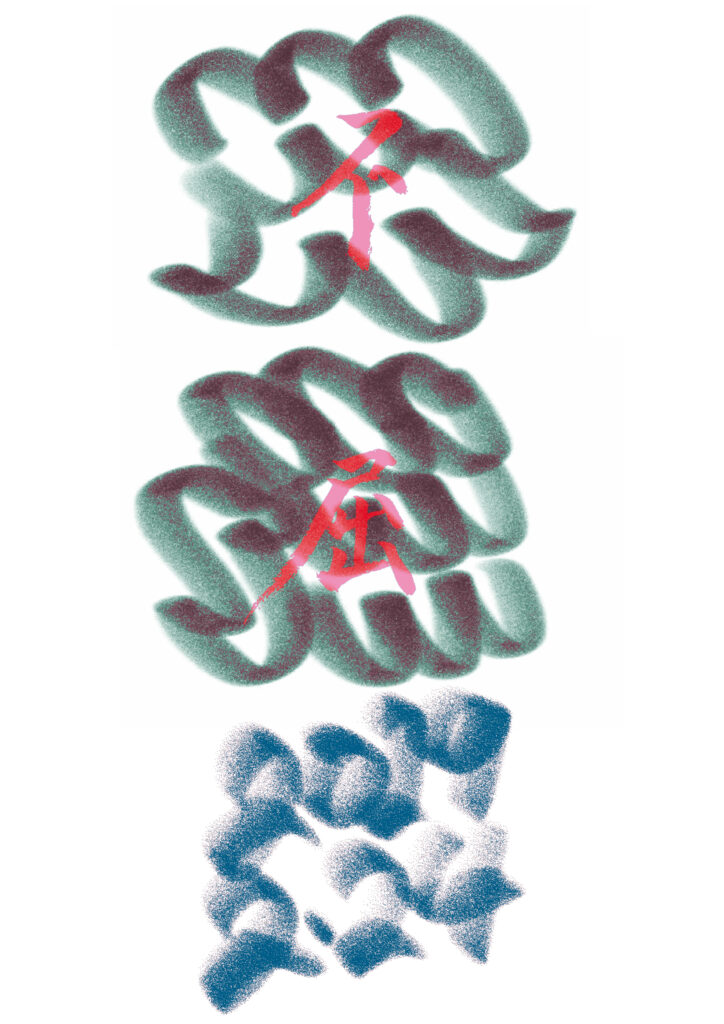
デザイン:山本悠 |design: Yuu Yamamoto
🌊「不屈」と「2019.2.24」について|Fukutsu and 2019.2.24🌳
「不屈」は、沖縄の政治家・瀬長亀次郎が、アメリカ軍統治下において弾圧を受けながらも闘い続けたなかで、とくに好んで揮毫した言葉です。圧政に屈しないこと、不条理や納得できないことが起きても諦めず、自分たちの信念のために交渉していくこと。「2019.2.24」は辺野古米軍基地建設のための埋立ての賛否を問う県民投票が実施された日であり、反対が7割以上を占めていました。
何年も続く闘争と、その暴力が現在も様々な形で継続されていることを受けて、ひがれおさんと遠藤麻衣の文字を重ねたデザインを作り、丸山美佳と三人でパッチや服に印刷しました。森美術館の「六本木クロッシング 2025」のオープニングでは、宮田明日鹿さんとともに身につけました。
宮田さん、ひがれおさんとは六本木クロッシングへの参加にあたり何度も会話を重ね、日常と地続きにある芸術実践をどう考えていくのか、美術館で展示する事への率直な悩みや思いを共有してきました。その中で共有された一つが、ひがれおさんによる次の文章(一部加筆修正済)です。
Fukutsu (“indomitable”) was a term frequently used and favored by Kamejirō Senaga, an Okinawan politician who resisted repression of the U.S. occupation forces. He conveyed the message that we should not succumb to oppression, that we should not give up even when faced with absurdity or injustice, and that we should continue to negotiate for the sake of our beliefs. On February 24, 2019, an Okinawa prefectural referendum was held to determine public approval or opposition to the landfill work for the construction of the U.S. military base at Henoko. In this referendum, over 70 percent of the votes were in opposition.
In response to the long-standing struggles and the persistence of violence in various forms, Higaleo and Mai Endo created a design overlaying the lettering of “fukutsu”, and the design was printed on patches and clothing with Mika Maruyama. We wore together with Asuka Miyata at the opening of the exhibition Roppongi Crossing 2025 at the Mori Art Museum.
During the preparation stage of the exhibition, we, as Multiple Spirits, held numerous discussions with Higaleo and Asuka, sharing our thoughts and candid concerns about how to navigate artistic practices that are part of our everyday lives and what it means to present such work within a museum setting. The following text was written and shared by Higaleo during those discussions (slightly edited for this website).
現在、日本国内の米軍基地の約 70%が、国土のわずか 0.6%に過ぎない沖縄に集中しています。この背景には、1609 年の日本・薩摩藩による琉球王国の侵略とその後の併合、日本軍 – 米軍 – 自衛隊に連なる軍事化と、連動する構造的差別があります。 日本政府は、こうした植民地的な権力関係や沖縄への差別を公式に認めていないため、この問題を社会全体の課題として広く共有することは、いまだに容易ではありません。
このような困難な状況の中で、沖縄内外のアーティストが表現を通じて沖縄を描き続けてきました。しかし、日本社会の無関心と無理解から、それらはしばしば「日本の問題」ではなく「沖縄の人々の問題」として眼差されます。アーティストの試みもまた、アート関係者を満足させるための鑑賞物として消費されかねない状況に常に晒されているのです。
私が生まれた1995 年は、普天間基地の移設問題が持ち上がった年です。30年前、複数の米兵による少女へのレイプ事件が発生しました。これは繰り返されてきた凄惨な事件・事故に連なるもので、人々の社会的トラウマや怒りを爆発させる契機となりました。その結果、基地負担の軽減と、住宅街に隣接する普天間基地の移設を求める声が一気に高まりました。
米軍は、移設には普天間と同等の機能を持つ新たな基地が必要だとし、日本政府はその建設先として、他の都道府県ではなく沖縄島北部の辺野古を選びました。辺野古の計画は、滑走路の長さが不十分で、完成しても普天間の代替機能を満たさず、移設が果たされない可能性が指摘されています。さらに、海底地盤は極めて軟弱で、完成までに数十年を要するという見方もあります。実際に工事は大幅に遅れており、死傷事故も発生しました。その現場に建設作業員、あるいは抗議者として立ち、対立に晒され続けているのも沖縄の人々です。この移設問題は長らく選挙の争点となり、住民投票でも繰り返し新基地建設や埋め立てへの反対が示されています。
沖縄の人々が地位を踏みにじられ、環境破壊と過剰な基地負担を強いられている一方で、大林組、鹿島建設、大成建設といった大手ゼネコンは、工事の長期化によって莫大な利益を得ています。こうした不公正な構造は、今この瞬間も続いています。そして、その末端に現れているのが、ゼネコンによるアート界へのスポンサーを通した財力的影響と、そこに関わる展覧会や作家ら、アートワーカー達との関係性ではないでしょうか。
私は、沖縄に生きる人間としての経験と魂を手放すことなく、同時にアートの可能性を信じる者として、尊敬と敬意を込めて皆さんと関係性を築いてゆくことを希望します。まずこうした歴史や背景をお伝えすることが、今の私にとって最も誠実な選択でした。
Currently, approximately 70% of all U.S. forces in Japan are located in Okinawa, which accounts for only 0.6% of Japan’s total land area. Several background factors contribute to this burden: the invasion and subsequent annexation of the Ryukyu Kingdom by the Satsuma Domain of Japan in 1609, followed by successive militarization in Okinawa through the Imperial Japanese Army, the U.S. military occupation, and the Japanese Self-Defense Forces, as well as the structural discrimination intertwined with these processes.
Thus far, the Japanese government has not officially acknowledged these colonial power dynamics or the discrimination against Okinawa. Therefore, it is extremely challenging to share and recognize this issue as one that concerns Japanese society as a whole.
In the face of such difficulties, artists from within and beyond Okinawa have continued to depict and express Okinawa through their works. However, due to widespread indifference and misunderstanding within Japanese society, these works are often viewed as representing not an “issue in Japan” but “a problem of the Okinawan people.” The efforts of these artists are constantly at risk of being consumed merely as aesthetic objects meant to satisfy the art world.
The year I was born, 1995, was also the year controversy over the relocation of the Futenma Air Base arose. This stemmed from a brutal incident in which a young girl was raped by multiple U.S. servicemen. It was one in a long series of tragic incidents and accidents associated with the base, triggering public outrage and profound social trauma. In response, demands rapidly grew to reduce the burden of the U.S. military presence on the Okinawa Islands and to relocate Futenma Air Base, located adjacent to residential neighborhoods. However, the U.S. military insisted that relocation would require a new base with functions equivalent to those of Futenma Air Base, and the Japanese government chose Henoko in northern Okinawa Island as the new location, rather than any other prefecture in Japan. The Henoko plan has been criticized for its inadequately short runways, meaning that even if completed, it may not serve as a functional replacement for Futenma Air Base. Furthermore, the seafloor in Henoko is extremely soft, and some experts predict it could take decades to complete the construction. In fact, the construction has already been significantly delayed, and fatal accidents have occurred. The people of Okinawa stand on that site, both as construction workers and protesters, continually causing conflict and division within the community. This relocation issue has long been a central topic in local elections, and residents have consistently voiced opposition to the new base and land reclamation.
While the people of Okinawa have their dignity trampled upon continuously, suffering from environmental destruction and the heavy burden of hosting many U.S. forces, Japanese “super general contractors” such as Kajima Corporation, Taisei Corporation, and Obayashi Corporation have been reaping enormous profits from the prolonged construction. This unjust structure persists to this day. At the same time, this dynamic is reflected in the art world at the end of this power structure, with the financial influence wielded by such construction companies and the intricate relationships with exhibitions and art workers they support.
As an Okinawan who lives in Okinawa and believes in the power of art, I hope to build relationships with all of you rooted in respect and sincerity so that I do not relinquish my experiences and my spirit. Sharing this history and background with you is, for me, at this moment, the most honest choice I can make.
ひがれお |Higaleo
土産品や手工芸品のリサーチを手がかりに、日常に潜む政治性や過去の痕跡をたどる作品を制作している。切り絵や映像、インスタレーションを用いて、個人と土地、生活と歴史が交錯する場のありようを描く。2024年にアーティストネームを西永怜央菜からひがれおへ改名。
Drawing on research into souvenirs and handicrafts, Higaleo creates works that trace the politics embedded in everyday life and the remnants of the past. Through kirigami (paper cut-outs), video, and installation, their work portrays spaces where individuals and land, daily life and history, intersect. They changed their artist name from Reona Nishinaga to Higaleo in 2024.